
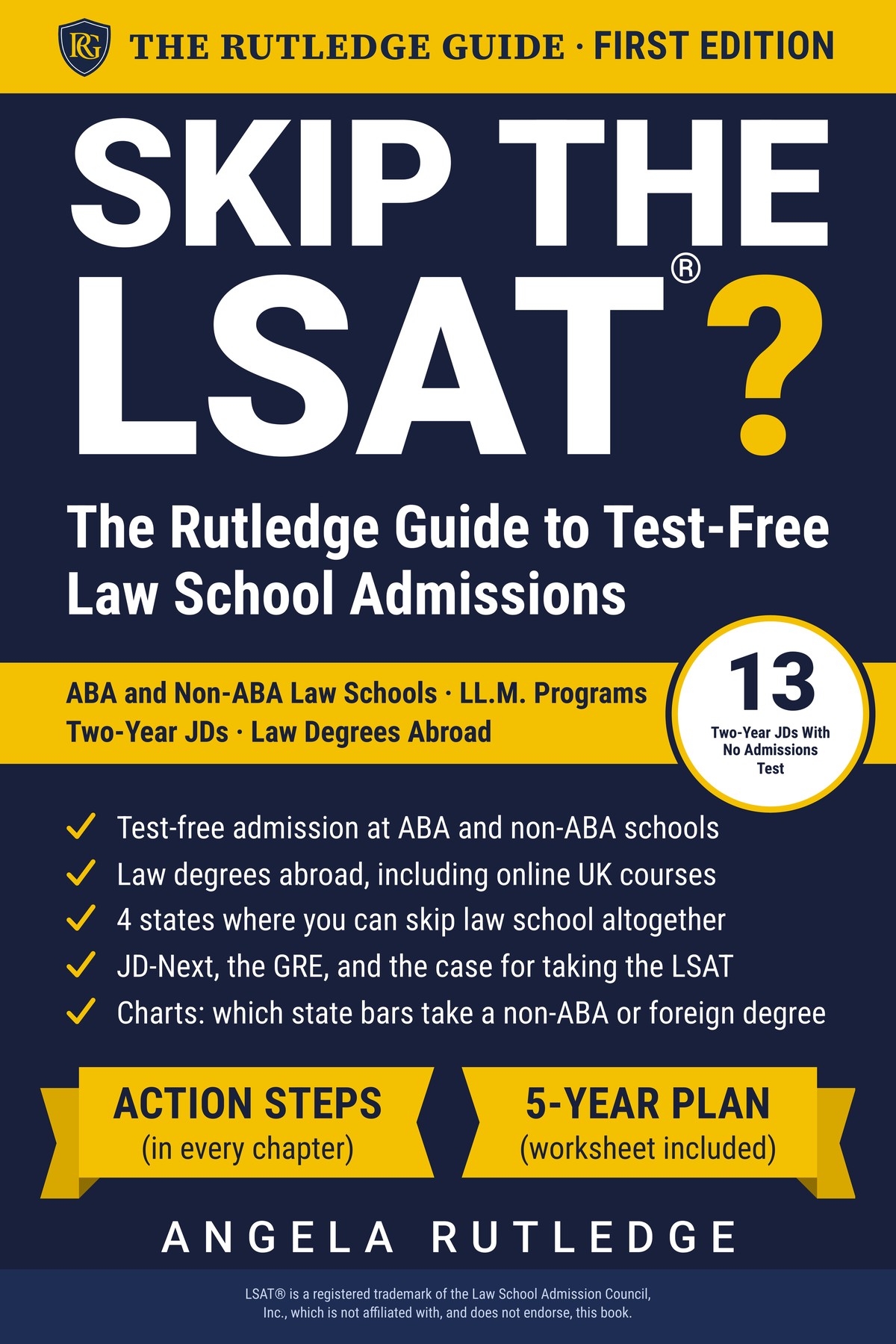
Have the book?
Everything the book sends you here for is one click away.
My own judgment. Nobody measured it.
Most of you should take the LSAT
I'll say it before you spend a dollar: 95 percent of you should take the LSAT. That number is my own judgment. Nobody measured it.
If you've just finished your bachelor's degree and you're in your 20s or early 30s, take the LSAT. You still have the habit of studying hard every week, and that habit fades. A good score widens your choices: more schools say yes, more of them offer money, and you keep room to change your mind later about where you live and what kind of law you practice.
You belong in the 95 percent if any of these is true:
- 1You want the widest choice of ABA schools, or their scholarship money.
- 2You might move to another state, or you want a job where the name of your law school counts.
- 3You're in your 20s or early 30s and still in the habit of studying.
- 4You haven't confirmed, in writing, that your no-LSAT route leads to the bar you want.
If that's you, close this page and go buy an LSAT prep book. The book has a full chapter arguing that side, and I'd read it before deciding anything.
Who the 5 percent are
This book is for everyone else. In my experience, the people who should seriously consider skipping the LSAT fall into a handful of groups.
You're settled.You know where you'll live and work for the rest of your career, you want to practice locally or work for yourself, and you aren't chasing big-firm jobs or ABA scholarship money.
You're established in business,or you're taking over a family business, and a law degree would make you better at work you already do.
You want the degree for the job you have now,or you've always wanted one and have no plan to practice.
Your life crosses borders.You hold two passports, or you don't know which country you'll end up in. That's the road I took and the reason I took it.
Or you're firmly against the LSAT.Then read Chapters 5 and 6 before you commit to that position. They push back on it harder than I do here.
Age by itself isn't on this list. I started law school at 41, and being over 40 makes some of these reasons more likely to apply to you. A 45-year-old who wants ABA scholarship money should still take the LSAT.
The routes, counted properly
In August 2026 I posted a one-minute TikTok video on six ways to get into law school without the LSAT. Six items work on TikTok. A careful reader will find the problems in about a minute, so the book points them out itself. Counted properly, the six become this.
If you hold a bachelor's degree in something other than law, you have three doors.
The catch: it limits which bar exams you can sit.
The catch: it depends on a school choosing you, and the list of schools holding a variance is short and changes.
A graduate in any subject can start a conversion course without an entrance exam.
The catch: it takes years, and the credential you finish with has to be the kind a US bar will accept.
If you already hold a foreign law degree, you have two next steps: a one-year LL.M. or a two-year JD.
If you're still an undergraduate, you have a side door: a 3+3 or a direct admission program at your own university's law school. Many of these still require the LSAT.
A route that skips law school altogether. Four states let you qualify for their bar by studying in a law office under a supervising lawyer: California, Virginia, Vermont, and Washington.
What's in the book
- ✓Test-free admission at ABA-approved and non-ABA law schools, and what a non-ABA degree will and won’t let you do
- ✓Six step-by-step flow charts, each tracing one route from day one to admitted attorney, with no LSAT
- ✓Law degrees you can earn abroad, including UK conversion courses taught online
- ✓The choice between an LL.M. and a two-year JD if you already hold a foreign law degree, with 13 two-year JD programs that list no admissions test requirement
- ✓The four states where you can qualify for the bar by studying in a law office, with no law school at all
- ✓Online and hybrid JD programs at ABA-approved law schools, and non-ABA law schools you can attend online
- ✓JD-Next, the GRE, and joint degrees, for readers who will sit some test
- ✓A full chapter on why you should seriously consider taking the LSAT anyway, including what the federal limits on student loans mean for paying for law school
- ✓Charts showing which state bars take a non-ABA or foreign law degree
- ✓Four maps showing where every state and D.C. stands on non-ABA and foreign law degrees
- ✓A five-year plan in seven steps, with three worked examples, two sample plans, and a worksheet to fill in
Every chapter ends with Exhibit A, which is either how I did it or a real example of what that path looks like, followed by a short list called Do this next. Four appendices list programs school by school, and the rules, prices, and deadlines are cited to their sources so you can check them yourself.
Buy the book →What you may give up
This guide doesn't promise a shortcut. Each test-free route trades the test for something else: fewer states where you can practice, a lower bar pass rate, or more years of study. The book shows you the trade before you make it.
Skipping the LSAT means choosing another path, and another path can lead to other results. You may lose your chance at some ABA schools. You may walk away from thousands of dollars in scholarship money, and I'd call that a strong possibility. If you want the most prestigious jobs in law, take the LSAT.
Where does your state stand?
Before you pick a door, decide where you want to practice. That answer rules routes in and out, and it's the step people skip. The map sorts every state and D.C. into three groups for a reader who doesn't plan on an ABA JD.
Open the bar rules map →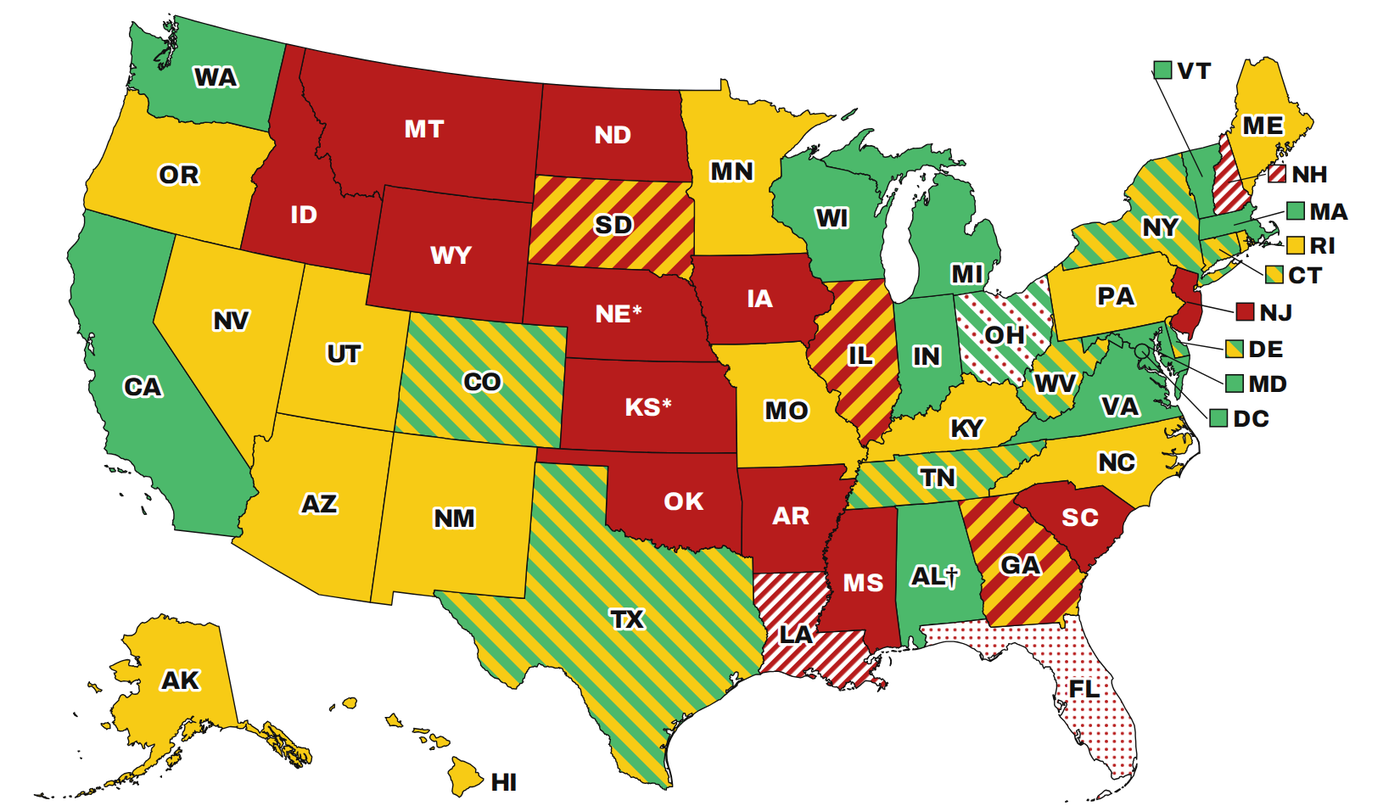
Get the book
Read it on a Kindle or in the Kindle app. The notes link to their sources.
Kindle edition on AmazonThe audiobook, read by the author, is coming to Audible.
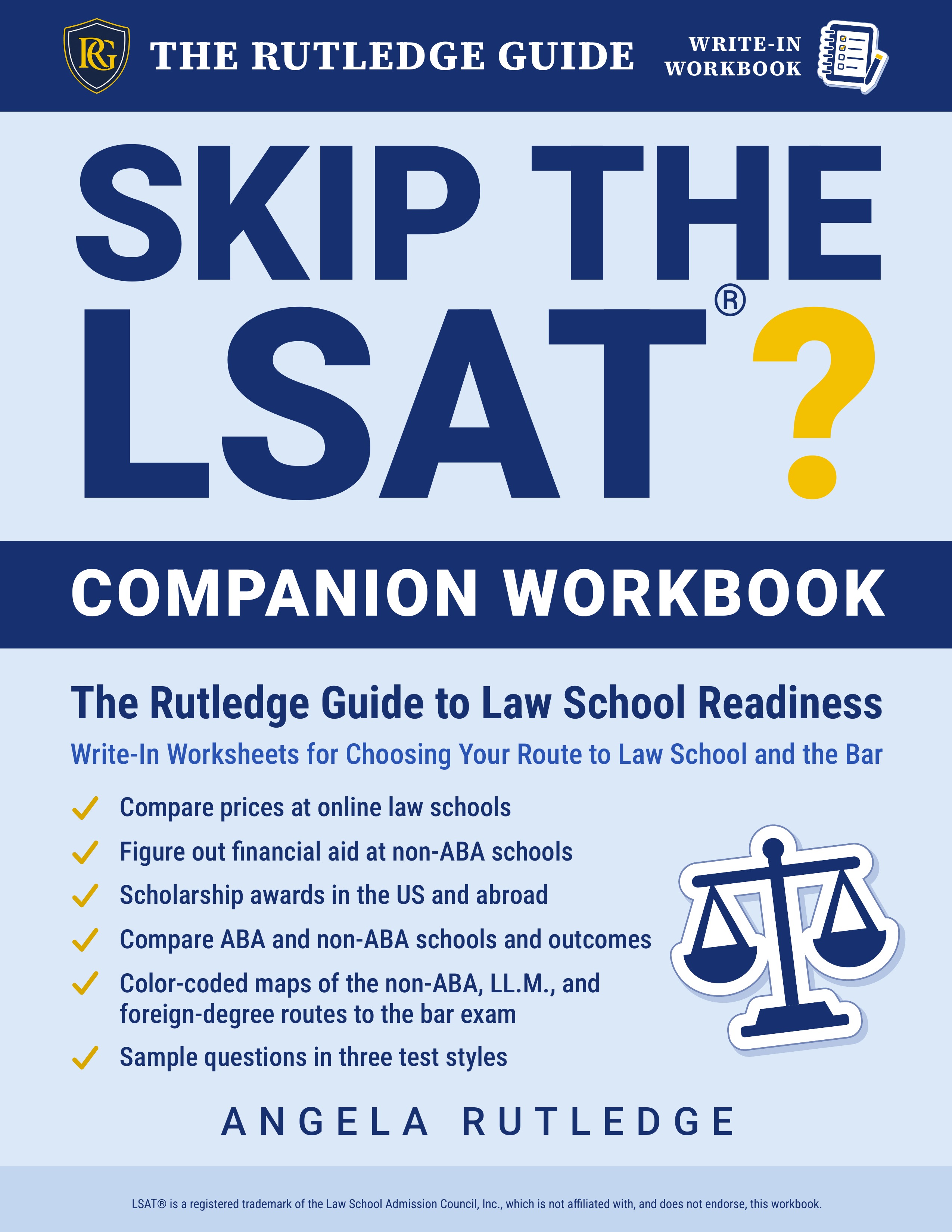
The companion workbook
Skip the LSAT? Companion Workbook: The Rutledge Guide to Law School Readiness is sold separately. It goes with the book, and it also works on its own for anyone getting ready to apply to law school. It's where you work out on paper whether you're ready for law school and which way in fits your life. It gives the five-year plan more room, and it has a chapter for working out your own finances on paper.
On Kindle, in paperback, and in hardback.
Get the workbook on Amazon →
About the author
Angela Rutledge has never sat the LSAT. She started law school at 41 with three children under three, earned an LLB from the University of Law in England, and then an LL.M. from George Mason University's Antonin Scalia Law School. She works as a court-appointed criminal defense attorney for a Nebraska-based Tribal Court. Her strength, though, is the support role. Through her business, Legal Writer & Law Clerk, she researches and drafts for attorneys in the US and solicitors in the UK.
More about Angela →Next: The Other Way In
My next book, The Other Way In, is about nontraditional paths to becoming an attorney, and it goes into how to pay for them.